There is a moment on every serious project when the spreadsheets stop mattering and the people start. For Power Plant Energy, that moment came last week in the Burdekin — a district built on large-scale irrigated agriculture — over two days of meetings, farm visits, and one jaw-dropping tour of the water infrastructure that makes the whole district possible.
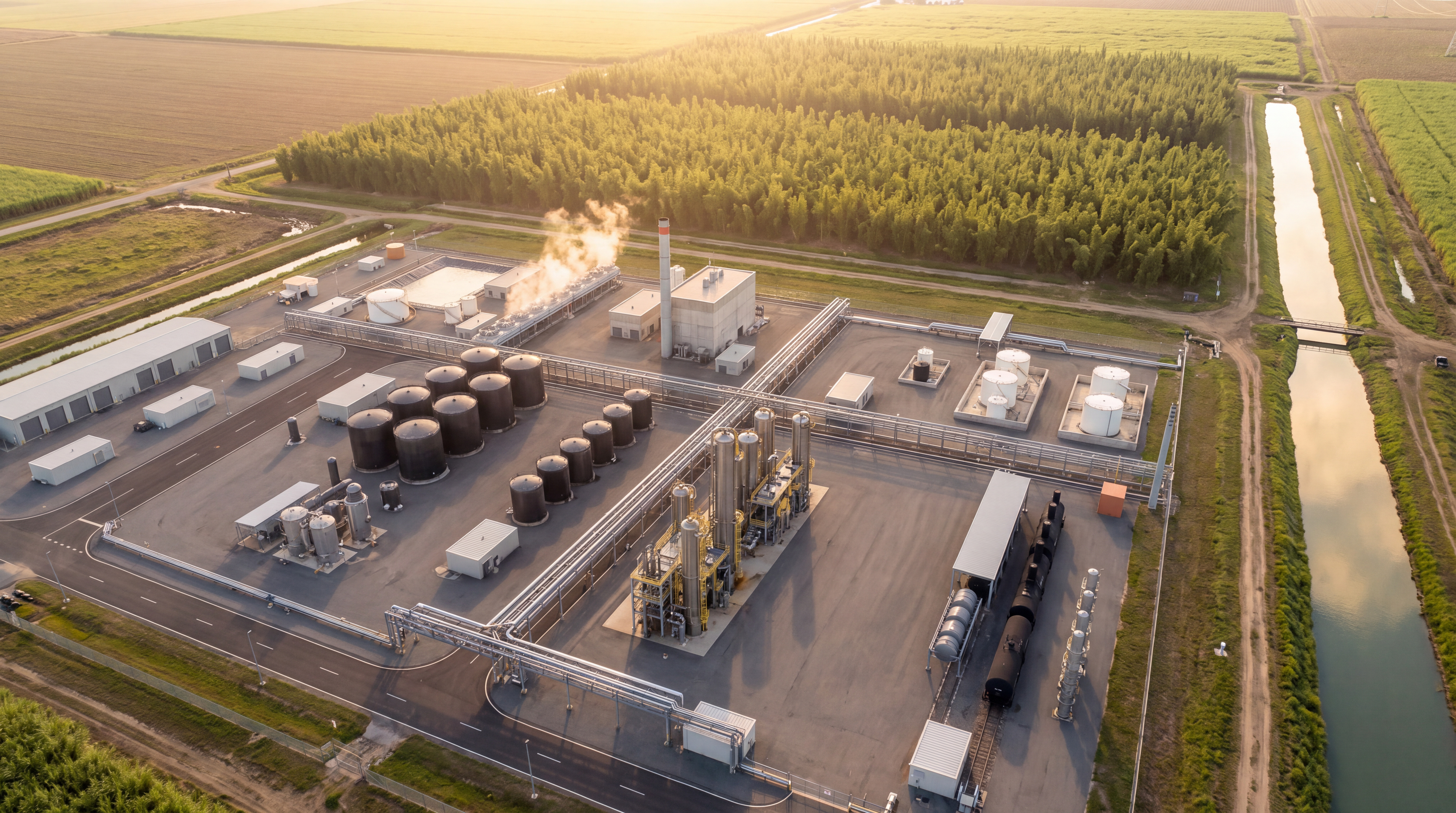
We flew north from Melbourne with a proposal that is, on its face, counterintuitive: asking the heartland of Australian sugar to help us grow a different grass — energy-bred bamboo — and to rezone at least 50 hectares of suitable land to high-hazard industrial use, so we can build the sustainable aviation fuel and battery anode production facility at the centre of what we call the Power Plant Energy Prism Burdekin complex.
We returned with something far more valuable than we asked for.
First, the Growers
Before we presented to anyone in a suit, we sat with the people who would actually grow the crop: the Burdekin Cane Growers Board of Directors.
This mattered to us more than any other meeting on the itinerary, and we deliberately held it first. The district's growers are not a stakeholder to be managed — they are the foundation of the entire model. A century of grass-farming knowledge lives in these families: the soil prep, the fertigation, the harvest logistics, the ratoon management. Our project works precisely because bamboo is a giant perennial grass, and nobody on earth manages giant perennial grasses better than the Burdekin.
The bond we built with the Board in that room is something we will protect as carefully as the crop itself. Their endorsement of the project — given after the kind of detailed, probing questioning that only people with real skin in the game can deliver — became the blessing that carried us into every meeting that followed. When the growers of a district say yes, everyone else in that district listens differently.
Then, the Council
With the growers' endorsement behind us, we presented to the Burdekin Shire Council — the Mayor, the Executive Leadership Team, and a number of Councillors — and we did not bury the ask.
We formally requested two things: the Council's support, and the rezoning of suitable land to high-hazard industrial on a site of at least 50 hectares, to host the fuel and battery anode production facility.
Here is what we did not expect: the Council had already done its homework. They had identified two sites to allocate for exactly this purpose. They committed their support wholeheartedly — and made it unmistakably clear that the region intends to support this project in any way it can.
Read that again, because we had to as well. A local government, presented with a first-of-kind industrial proposal from a company new to the district, responded not with caution but with prepared sites and an open door. That is what it looks like when a region decides its own future rather than waiting for one to arrive.
The Water
Every biofuel and bioprocessing proposal lives or dies on one question, and it is not the technology. It is the water.
Sunwater answered it without hesitation: the water requirements of the facility are completely covered, and there are no concerns from their perspective regarding the facility and its needs.
To understand the weight of that sentence, you have to see what we saw. Our tour of the Burdekin Haughton Water Supply Scheme — the pumping stations, the weirs, the dams, the locks, the metering technologies — was nothing short of jaw-dropping. This irrigation scheme is a jewel in the crown of Australian agriculture and of this country's agro-industrial future. It underpins everything. Its size and scale are enormous, and its impact is bountiful. Australians built this, generations ago, and it is still delivering.
Meetings with the Department of Primary Industries, Sugar Research Australia, and Lower Burdekin Water carried the same quality: insightful, welcoming, and rigorous. Together they gave us a certainty that seldom exists when you're developing a project of scale that is new to an area and different from what has been done there for a hundred years. That certainty is not a courtesy. It is earned — by the region's institutions being genuinely excellent at what they do.
The Local Champion
We also had the opportunity to sit down with Dale Last MP, the local member.
Dale's public support for the recent development of liquid fuels in the region has been a standout, and his enthusiasm for our project set yet another level of confidence in motion. When your local MP has already championed the sector you're building in, the conversation moves quickly past whether and straight to how.
A Special Thanks — Twice Over
Two debts of gratitude need to be placed on the public record.
The first is to Greg Watson of Burdekin Cane Growers, who worked tirelessly to arrange every one of these crucial meetings — the Board, the Council, Sunwater, DPI, Sugar Research Australia, Lower Burdekin Water, the MP's office, the farms, the harvester, even the harvest fire at dusk. Projects like this are often judged on the quality of their engineering. They are built, in truth, on the quality of their introductions — and Greg opened every door that mattered, in the right order, with the right people. This trip exists because he did.
The second is to the individual growers and organisations who have already offered land and enthusiasm to grow the bamboo this project needs. We came north with high hopes. We could not possibly have expected so many individuals to offer so much land — and to be so willing to engage in 25-year growing agreements — in such a short time.
That response changes everything about our position. We are now very strongly positioned to go to market and raise the required capital, because we believe we are the only project in the country that can wholeheartedly and truthfully say: we have feedstock surety. Not projected feedstock. Not feedstock contingent on policy settings or externalities. Feedstock committed on farms, with growers, for twenty-five years.
Are the contracts signed yet? No. But when a grower looks you in the eye and gives you their word on their own land, you understand that the contract is a formality — and the formality carries far less weight than the agreement already made. That doesn't shift when the political wind does — because we built this project on solid foundations.
Now we get to stand up a new home in the Burdekin.
What Astounded Us
We want to be honest about what struck us most, because it wasn't the approvals or the sites or the water.
It was the level of understanding. The depth of the questions. The investigation these groups had clearly done before we arrived. The open-mindedness of every single meeting, face to face, across two full days — from a harvest fire at dusk with Joel Betteridge at Home Hill, to a harvester running in the morning, to boardrooms and electorate offices.
There is a great respect and appreciation in this community — for their region, and for cooperation itself — that was, as Australians, an absolute throwback to what we always believed this country was. It turns out those tenets still live on in our modern era. In the cities, everything can feel different. But in these regional communities, they carry the torch.
And that torch is lighting the way to an immensely bright future.
The Sentiment We Flew Home With
We returned to Melbourne with one clear conviction:
Far North Queensland is open for business — if your business is well thought out, well planned, considers every local element and vector, and is built around productivity, community, and appreciation.
And we returned with the one asset no competitor can claim and no market can take away: growers, land, and twenty-five years of feedstock surety, committed.
The beautiful scenery. The incredible people. The awe-inspiring natural conditions. The soul of the Burdekin is something we hope to capture and carry forward as we bring this new industry, and with it new activities, jobs, opportunities, and businesses, to the region.
The Power Plant Energy Prism Burdekin complex is no longer a proposal on a page. It is a project with growers behind it, a council beside it, water beneath it, and a community around it.
Now we build.